
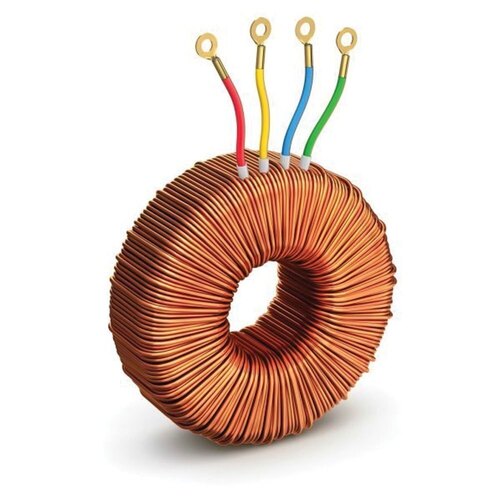
How toroidal transformer geometry and pure copper windings eliminate electromagnetic hum, reduce stray fields by 90–95%, and deliver the clean, stable power that high-fidelity amplifiers require.
High-fidelity audio design is fundamentally about preserving signal purity. Every component in the signal chain — from the preamp to the power supply — plays a role in determining how faithfully sound is reproduced. Among these components, the transformer is particularly critical because it directly affects electrical noise, power stability, and overall audio clarity.
Two transformer designs dominate audio power supplies: the traditional E-I laminated transformer and the toroidal transformer. While both perform the same basic electrical function, their mechanical construction and magnetic behavior lead to significant differences in noise performance, efficiency, and suitability for sensitive audio circuits.
The Noise Problem in E-I Transformers
In any sensitive audio circuit, the primary obstacles to achieving a high signal-to-noise ratio are electromagnetic interference (EMI) and mechanical vibration.
Stray Magnetic Fields
Standard E-I transformers are constructed from stacked "E" and "I" shaped steel laminations. While this design is robust and cost-effective, it introduces microscopic air gaps at the joints where the laminations meet. These air gaps create high-reluctance points in the magnetic circuit, causing part of the field to leak outward.
- 1Stray magnetic fields radiate outward from the transformer.
- 2These fields couple with nearby signal traces or high-gain preamp stages.
- 3Induced 50 Hz or 60 Hz hum (and harmonics) enters the audio path.
Magnetostriction and Mechanical Buzz
- 1Magnetostriction causes the iron core to slightly expand and contract as the magnetic field oscillates.
- 2In laminated cores, these tiny dimensional changes cause plates to vibrate against each other.
- 3This produces audible mechanical buzzing at twice the mains frequency.
- 4Vibrations transmitted through the amplifier chassis may be picked up by microphonic components, further contaminating the audio signal.
The "Audible Silence" of Toroidal Transformers
Toroidal transformers address these issues through a fundamentally different geometry. Instead of stacked laminations, the core is formed from a continuous ribbon of grain-oriented silicon steel wound into a ring shape. This design creates a seamless magnetic path with no air gaps or sharp discontinuities.
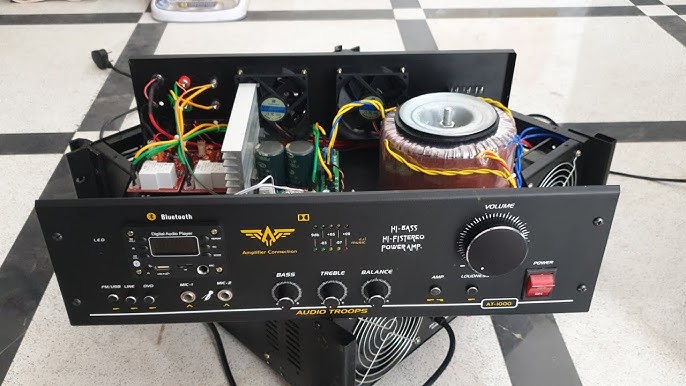
Contained Magnetic Flux
- 1The circular geometry keeps magnetic flux tightly confined within the core itself.
- 2Minimal magnetic leakage and reduced electromagnetic interference.
- 3Toroidal transformers typically reduce stray magnetic fields by 85% to 95% compared to equivalent EI transformers.
Mechanically Quiet Operation
- 1Uniform winding distribution around the entire 360-degree circumference.
- 2Symmetrical magnetic forces minimize vibration.
- 3Tightly wound coils damp mechanical movement.
- 4The result is a transformer that is nearly silent both electrically and mechanically — allowing subtle sonic details like the decay of a reverb tail to remain clearly audible.
Why 100% Copper Windings Are Essential
Superior Electrical Conductivity
- 1Copper offers an IACS conductivity of approximately 100%, while aluminum reaches only about 61%.
- 2Lower DC resistance for the same wire gauge, resulting in reduced I²R power losses.
- 3Lower resistance also means less heat generation within the transformer.
Faster Transient Response
- 1Music signals — especially bass notes and orchestral peaks — contain rapid transient current demands.
- 2Copper windings allow the power supply to deliver fast current spikes with minimal voltage drop.
- 3This ensures the amplifier maintains dynamic headroom during demanding passages.
Greater Thermal Stability and Current Density
- 1Copper has a lower coefficient of thermal expansion than aluminum, providing greater structural stability under heat.
- 2Copper can carry significantly more current for a given conductor size, allowing more compact, higher power-density designs.
- 3As a result, powerful audio amplifiers can remain physically compact without compromising performance.
Toroidal Transformers vs. SMPS in Audio Amplifiers
Modern electronic devices increasingly use Switch Mode Power Supplies (SMPS) due to their lower weight and reduced manufacturing cost. However, many high-end audio amplifiers — particularly Class A and Class AB designs — still rely on traditional toroidal transformers.
- 1SMPS units operate by rapidly switching MOSFETs at frequencies ranging from kilohertz to megahertz. This switching introduces high-frequency electrical noise and ripple currents that can create intermodulation distortion perceived as a harsh or brittle sound character.
- 2SMPS designs rely on active current limiting to protect semiconductor components, which can restrict the supply's ability to deliver large transient currents.
- 3A toroidal transformer is a passive magnetic device capable of handling short-term current surges without imposing strict limits — critical for subwoofer transients, sudden bass impacts, and large orchestral crescendos.
- 4For audiophiles seeking unrestricted dynamics and natural sound reproduction, the toroidal-based linear power supply remains the preferred choice.
Conclusion
Although modern power supply technologies continue to evolve, the toroidal transformer remains the benchmark for high-performance audio amplification. Its advantages include dramatically lower stray magnetic fields, near-silent mechanical operation, superior current delivery when paired with copper windings, and clean, stable power free from high-frequency switching noise. For engineers designing systems where signal purity, dynamic response, and low noise floors are critical, the toroidal transformer continues to represent the gold standard in power supply design.